For the first time in a long time, I finally feel like I got it right this Christmas. No frantic last-minute gift shopping, no calendar packed with parties, no elaborate decorations and, perhaps most importantly, no (well, at least very little) stress.
How did I go from secretly dreading the holiday season to rekindling my love for Christmas? It started with a book I picked up from the library - The Simple Living Guide - which has an entire chapter devoted to simplifying the holidays. The author, Janet Luhrs, encourages readers to forgo the hustle and bustle of holiday shopping and parties and instead keep the entire month of December open for time with the family. She also extols keeping the materialism of the season at bay and thinking creatively when it comes to gifts. Make things, shop at thrift or consignment stores, give experiences, etc. No matter what you do, she recommends removing yourself mentally from the frenetic nature of holiday gift-giving and instead focusing on the true meaning of the season: celebrating family, friends and faith.
Inspired, I set out to simplify our Christmas. It started with limits on gifts. We decided to get each of our boys two gifts. We set a $50 limit on gifts for spouses. We talked to our respective families, both of which decided to do no gifts for adults. We told grandparents to please only get one gift for each child (no easy task!). In addition to making for a less crazy shopping experience, limiting the extravagance of the season helped us bring back the focus of the holiday season to giving vs. receiving. Our hope is that on Christmas morning we'll be more thankful for - and not overwhelmed by - presents. (As I'm finally getting this post up after Christmas - so it goes with two kids - I'll share that one of my favorite things that morning was watching my two-year-old spend five minutes reading the first gift he opened from Santa, a book about fire trucks. His presents from grandparents, wooden blocks and a wooden train set, have been played with constantly since Christmas morning. It's wonderful to see him truly appreciate his gifts, and I believe that's because he's not buried by them.)
Probably the biggest change we made this year was adopting a family for Christmas. In November I called local charities and found a single mom and her son that were in need. This project brought special meaning to the season, as we carefully chose gifts that would be helpful to her in a new job and I used my now-honed-mom-of-two-boys skills to find things for her son. Even my hairdresser donated a haircut and style, which left me speechless. The process of putting together gifts and food for this family warmed my heart and reminded me of the true meaning of Christmas.
Finally, to simplify our holiday calendar we limited our engagements to a max of one per week. Instead we spent a lot more time with our family, enabling us to do things like cut down a Christmas tree for the first time with our kids (so fun!), drive around Napa looking at Christmas lights (live locally? Don't miss Paradise Drive), watch the original Rudolph movie with our two-year-old, bake lots of cookies, do an Nativity-themed Advent Calendar every day, and celebrate the Feast of St. Nicholas with the tradition of treats and small presents in shoes.
Limiting commitments also gave us ample time to teach our two-year-old about the story of Jesus' birth so that he understands why we celebrate with cookies, parties, presents, a visit from Santa Claus, etc. The Advent calendar was a big part of this, as were books including The Little Drummer Boy, The First Christmas and the Usborne Nativity Flap Book. It has been such a blessing to watch our little guy really get Christmas this year. The joy on his face throughout the season has been a constant reminder to cherish this time of year.
I know that what's "right" for our family in celebrating Christmas may not be "right" for everyone, but I hope our process of getting to a truly happy holiday encourages other families that may also be overwhelmed by the season. We took time to think deliberately about what we wanted Christmas to mean to our family - the traditions we wanted to create and what we wanted to teach our children - and we tried to let the rest of it go. The result was a month of celebrating and giving that filled our souls and hearts with joy.
A very Merry Christmas & Happy Holidays to all!
Cheers,
Julie
You might also like...
1. Meal Planning: How we eat well on a $75 weekly budget
2. A Camping Convert
3. Easy, frugal and festive: Salt Dough Christmas Ornaments
Showing posts with label Kids. Show all posts
Saturday, December 27, 2014
Thursday, November 20, 2014
Do-it-yourself family photo shoot
To put it mildly, I love taking pictures. Oodles and oodles of them. I would even venture to say it's an addiction. One that's gotten much worse since having kids.
With the holiday season nipping at our heels, a few weeks ago I realized we didn't have a family photo with our newest addition, baby Ben. As you might imagine, I am one of those folks who has joined the Christmas card family photo craze. It's such an easy way to share a family update with friends and loved ones, though truth be told I miss the beauty and simplicity of classic Christmas card illustrations like the ones I grew up with.
It was time to drag - oops, I mean corral - the family outside and snap away!
Since becoming a mom and the Official Family Photographer, I've learned a lot about how to take a family photo. From investing in the right tools to brainstorming ideas to being the family cheerleader, there is a lot that goes on behind the scenes to take a good picture. But despite the time and effort, the final result is always worth it.
If you're frugal like me and prefer to take family pictures yourself - vs. hiring a professional photographer - I hope these tips will help you make your next family photo a great one.
1. Invest in a good camera: Yes, even a frugal person like me recommends investing a good camera, preferably a digital single-lens reflex camera, or DSLR. These cameras combine digital technology with the optics of old-school cameras and lenses. How much should you spend? These days you can get a DSLR for less than $500, including lenses. For example, you can find a used Canon Rebel on eBay for $250. Last year I upgraded to a Nikon D7000, which is a low-level professional grade camera, for around $500 (minus lenses). I got a great deal on a refurbished model because a newer model - the D7100 - had just been released. Check out websites like Slickdeals.net for the best deals. (Don't have a DSLR in your budget? Any point-and-shoot camera will do the job. If you find you like photography, you can always upgrade later.)
2. White Balance: I've found no other camera feature impacts the quality of photos as much as white balance - except, perhaps, focus. White balance influences the color tone in your pictures, making things like skin tone look natural or sallow. Find the white balance setting on your camera and play around with it to figure out what settings you like the best. There is much you can learn from your camera's manual on how to get started. The time of day and the place you are taking photos - for instance inside vs. outside - will impact the white balance settings, so take your time learning this feature. When using white balance settings for your family pictures, always take a few practice shots to make sure the colors look good.
If you're really up for perfecting the white balance in your photos, find out if your camera has a custom white balance feature. This enables you to set the white balance manually. Recently I invested in an Expodisc to help me do so with ease. The colors look great. Every. Single. Time.
3. Get a tripod: If you want to take your own family photos, this is a must. I've also gone the whole stacking-books-on-a-chair-until-they-are high-enough-to-hold-the-camera route, but it's incredibly frustrating and you never know when you're camera is going to topple off. For around $30 you can get a great tri-pod that you'll use for years.
4. Visit Pinterest for inspiration: What did I ever do before Pinterest? Last year was the first that I visited the site for Christmas photo inspiration and I wasn't disappointed. Within five minutes I had five easy ideas for Christmas card pictures, including the theme you see below. What did we end up doing for this year's Christmas card? Well, you'll just have to wait and see!
5. Get your props ready: Props for the photo to the right? A "Merry Christmas" sign from Target and a red Adirondack chair from our backyard. Other props for a Christmas card might be Christmas ornaments, Christmas lights, garland, etc. Gather these together so you're ready to go when the time is right. You might even have a few different ones to try so you have plenty of photo options to choose from.
6. Convince reluctant spouses/kids: Does anyone's husband love to take family photos? Mine needs a little friendly reminder that at least we're not hiring a professional photographer for $400. Also, I've found that promising to keep your "photo shoot" to a reasonable time limit (like 20 minutes) helps. And taking pictures right after a yummy meal.
7. Dress the part: You don't need to be matchy matchy, but it helps to think about what everyone will be wearing before you snap away. This year I found a great blog post on family portrait wardrobes, which was just the inspiration I needed for the vineyard photo above. Decide if you want everyone to be casual (jeans) or dressy (slacks). Make sure to choose colors that everyone looks good in, which in the winter tend to be colors that brighten skin tone (not, say, light gray). My favorite tip? Start the process by mom choosing her outfit so that she feels and looks good. Then match the rest of the family to what she's wearing.
8. Location, location, location: In my option, unless you have professional lighting outdoor family photos almost always look better than those taken inside. Scout out a few locations by looking for places that don't have a lot of "noise" in the background. For example, the Christmas photo above was taken in our backyard against a backdrop of trees - not facing the (messy) back of our house. The same concept goes for the vineyard photo above. Straight vineyard rows make for a simple setting that does not detract from the subjects. Don't have a good spot in your backyard? Check out your neighborhood park.
9. Face the light source: For faces to be illuminated and not in shadow, everyone should be facing the biggest light source. Inside? Face a window. Outside? Face the sun. Which brings me to...
10. Choose your timing wisely: Especially if you're taking pictures outdoors, this matters a bundle. I've learned over time that I get the best outdoor photos in the morning or late afternoon/sunset, or when it's cloudy outside. What you want to avoid is the sun beating down overhead and causing people to squint - or casting a lot of shadows.
11. Set up your gear before the family joins you: The time to keep the family focused on taking photos is limited. As much as possible, make sure everything is ready to go before rousing the troops.
12. Take test shots and focus your camera: Before going full throttle, take a few test shots and make sure the photo is framed as you would like it, that everyone can be seen in the photo, and that your camera is focused on the subjects. I can't tell you how many times I've gone through pictures to find the camera is focused on the trees rather than the people. Don't let this happen to you.
13. Put your camera on self-timer or buy a remote: Every point-and-shoot camera out there, and all DSLRs, have a self-timer function. If your camera has the capability, set it to take 5+ consecutive photos each time the timer goes off. You can also invest in a wireless remote if your camera is compatible.
14. Don't be too serious: OK, now is the time to have fun! Get in front of the camera, have everyone smile and start shooting. Take some photos where everyone is smiling and looking at the camera, and a few where everyone is looking at each other or, say, a baby. Laugh, squeeze each other, lean in, etc. My husband has even been known to lovingly pinch my bum to make me smile.
15. Different scenes: Take some photos where everyone can be seen head to toe, some from the waist up, and some sitting (or in another pose). Mix it up a bit because you'll find at the end that certain scenes really click and others don't.
16. Snap away: After five minutes you may think you've taken enough pictures. What I've found is that - especially when multiple people (and kids!) are involved - you get one good shot for about every 50 you take. Our family photo shoots typically result in a few hundred photos, of which ten might be decent (everyone looking at the camera, no funny faces, double chins, eyes closed, etc.). Of those ten, one or two is a winner. While even a hundred photos might sound like a lot, if they're taken at rapid-fire your photo shoot shouldn't take more than 15-30 minutes.
Best of luck with your next DIY family photo session! Have your own tip for taking great pictures? Please share in the comments.
Cheers!
Julie
You might also like...
1. Meal Planning: How we eat well on a $75 weekly budget
2. Make a ruler growth chart
3. Crochet a baby Yoda hat
With the holiday season nipping at our heels, a few weeks ago I realized we didn't have a family photo with our newest addition, baby Ben. As you might imagine, I am one of those folks who has joined the Christmas card family photo craze. It's such an easy way to share a family update with friends and loved ones, though truth be told I miss the beauty and simplicity of classic Christmas card illustrations like the ones I grew up with.
It was time to drag - oops, I mean corral - the family outside and snap away!
Since becoming a mom and the Official Family Photographer, I've learned a lot about how to take a family photo. From investing in the right tools to brainstorming ideas to being the family cheerleader, there is a lot that goes on behind the scenes to take a good picture. But despite the time and effort, the final result is always worth it.
If you're frugal like me and prefer to take family pictures yourself - vs. hiring a professional photographer - I hope these tips will help you make your next family photo a great one.
1. Invest in a good camera: Yes, even a frugal person like me recommends investing a good camera, preferably a digital single-lens reflex camera, or DSLR. These cameras combine digital technology with the optics of old-school cameras and lenses. How much should you spend? These days you can get a DSLR for less than $500, including lenses. For example, you can find a used Canon Rebel on eBay for $250. Last year I upgraded to a Nikon D7000, which is a low-level professional grade camera, for around $500 (minus lenses). I got a great deal on a refurbished model because a newer model - the D7100 - had just been released. Check out websites like Slickdeals.net for the best deals. (Don't have a DSLR in your budget? Any point-and-shoot camera will do the job. If you find you like photography, you can always upgrade later.)
2. White Balance: I've found no other camera feature impacts the quality of photos as much as white balance - except, perhaps, focus. White balance influences the color tone in your pictures, making things like skin tone look natural or sallow. Find the white balance setting on your camera and play around with it to figure out what settings you like the best. There is much you can learn from your camera's manual on how to get started. The time of day and the place you are taking photos - for instance inside vs. outside - will impact the white balance settings, so take your time learning this feature. When using white balance settings for your family pictures, always take a few practice shots to make sure the colors look good.
If you're really up for perfecting the white balance in your photos, find out if your camera has a custom white balance feature. This enables you to set the white balance manually. Recently I invested in an Expodisc to help me do so with ease. The colors look great. Every. Single. Time.
3. Get a tripod: If you want to take your own family photos, this is a must. I've also gone the whole stacking-books-on-a-chair-until-they-are high-enough-to-hold-the-camera route, but it's incredibly frustrating and you never know when you're camera is going to topple off. For around $30 you can get a great tri-pod that you'll use for years.
4. Visit Pinterest for inspiration: What did I ever do before Pinterest? Last year was the first that I visited the site for Christmas photo inspiration and I wasn't disappointed. Within five minutes I had five easy ideas for Christmas card pictures, including the theme you see below. What did we end up doing for this year's Christmas card? Well, you'll just have to wait and see!
5. Get your props ready: Props for the photo to the right? A "Merry Christmas" sign from Target and a red Adirondack chair from our backyard. Other props for a Christmas card might be Christmas ornaments, Christmas lights, garland, etc. Gather these together so you're ready to go when the time is right. You might even have a few different ones to try so you have plenty of photo options to choose from.
6. Convince reluctant spouses/kids: Does anyone's husband love to take family photos? Mine needs a little friendly reminder that at least we're not hiring a professional photographer for $400. Also, I've found that promising to keep your "photo shoot" to a reasonable time limit (like 20 minutes) helps. And taking pictures right after a yummy meal.
7. Dress the part: You don't need to be matchy matchy, but it helps to think about what everyone will be wearing before you snap away. This year I found a great blog post on family portrait wardrobes, which was just the inspiration I needed for the vineyard photo above. Decide if you want everyone to be casual (jeans) or dressy (slacks). Make sure to choose colors that everyone looks good in, which in the winter tend to be colors that brighten skin tone (not, say, light gray). My favorite tip? Start the process by mom choosing her outfit so that she feels and looks good. Then match the rest of the family to what she's wearing.
8. Location, location, location: In my option, unless you have professional lighting outdoor family photos almost always look better than those taken inside. Scout out a few locations by looking for places that don't have a lot of "noise" in the background. For example, the Christmas photo above was taken in our backyard against a backdrop of trees - not facing the (messy) back of our house. The same concept goes for the vineyard photo above. Straight vineyard rows make for a simple setting that does not detract from the subjects. Don't have a good spot in your backyard? Check out your neighborhood park.
9. Face the light source: For faces to be illuminated and not in shadow, everyone should be facing the biggest light source. Inside? Face a window. Outside? Face the sun. Which brings me to...
10. Choose your timing wisely: Especially if you're taking pictures outdoors, this matters a bundle. I've learned over time that I get the best outdoor photos in the morning or late afternoon/sunset, or when it's cloudy outside. What you want to avoid is the sun beating down overhead and causing people to squint - or casting a lot of shadows.
11. Set up your gear before the family joins you: The time to keep the family focused on taking photos is limited. As much as possible, make sure everything is ready to go before rousing the troops.
12. Take test shots and focus your camera: Before going full throttle, take a few test shots and make sure the photo is framed as you would like it, that everyone can be seen in the photo, and that your camera is focused on the subjects. I can't tell you how many times I've gone through pictures to find the camera is focused on the trees rather than the people. Don't let this happen to you.
13. Put your camera on self-timer or buy a remote: Every point-and-shoot camera out there, and all DSLRs, have a self-timer function. If your camera has the capability, set it to take 5+ consecutive photos each time the timer goes off. You can also invest in a wireless remote if your camera is compatible.
14. Don't be too serious: OK, now is the time to have fun! Get in front of the camera, have everyone smile and start shooting. Take some photos where everyone is smiling and looking at the camera, and a few where everyone is looking at each other or, say, a baby. Laugh, squeeze each other, lean in, etc. My husband has even been known to lovingly pinch my bum to make me smile.
15. Different scenes: Take some photos where everyone can be seen head to toe, some from the waist up, and some sitting (or in another pose). Mix it up a bit because you'll find at the end that certain scenes really click and others don't.
16. Snap away: After five minutes you may think you've taken enough pictures. What I've found is that - especially when multiple people (and kids!) are involved - you get one good shot for about every 50 you take. Our family photo shoots typically result in a few hundred photos, of which ten might be decent (everyone looking at the camera, no funny faces, double chins, eyes closed, etc.). Of those ten, one or two is a winner. While even a hundred photos might sound like a lot, if they're taken at rapid-fire your photo shoot shouldn't take more than 15-30 minutes.
Best of luck with your next DIY family photo session! Have your own tip for taking great pictures? Please share in the comments.
Cheers!
Julie
You might also like...
1. Meal Planning: How we eat well on a $75 weekly budget
2. Make a ruler growth chart
3. Crochet a baby Yoda hat
Sunday, June 8, 2014
Introducing Ben
I'd like to introduce the newest addition to our family - baby Ben.
Benjamin joined us in April to much fanfare, which included a cord prolapse (when the umbilical cord is delivered before the baby - never good) and an emergency C-section. Oh, and he was four weeks early. I will spare you the details, but suffice it to say that he's our miracle baby.
I quickly learned that caring for a new baby and chasing around a two-year-old doesn't leave much time for anything else. When you hardly have time to shower, you definitely don't have time to clip coupons and cook meals from scratch. My frugality (and my blog) has had to take a backseat to reality, a reminder that this is why we save - to give us the freedom to enjoy times like this with our family.
As the dust starts to settle, I look forward to getting back to meal planning, budgeting, squeezing the most out of each dollar and sharing the journey through my blog. But tonight, I think I'm going to go enjoy some cuddle time with baby Ben. As I've learned, that commodity is in very short supply.
Cheers!
Julie
Benjamin joined us in April to much fanfare, which included a cord prolapse (when the umbilical cord is delivered before the baby - never good) and an emergency C-section. Oh, and he was four weeks early. I will spare you the details, but suffice it to say that he's our miracle baby.
I quickly learned that caring for a new baby and chasing around a two-year-old doesn't leave much time for anything else. When you hardly have time to shower, you definitely don't have time to clip coupons and cook meals from scratch. My frugality (and my blog) has had to take a backseat to reality, a reminder that this is why we save - to give us the freedom to enjoy times like this with our family.
As the dust starts to settle, I look forward to getting back to meal planning, budgeting, squeezing the most out of each dollar and sharing the journey through my blog. But tonight, I think I'm going to go enjoy some cuddle time with baby Ben. As I've learned, that commodity is in very short supply.
Cheers!
Julie
Friday, February 14, 2014
A ruler growth chart for our growing family
Life is about to get more crazy wonderful - we are expecting a new addition to our family in April! Soon our family of three will be a family of four. What a miracle children are - to in an instant have a new little soul entrusted to your care. To both bring life into the world and forever have your life changed by it's blessing.
Our days of late have been filled with baby preparations and spending quality time with our toddler before his little life is forever changed. As you may have noticed by the lack of posts, in recent months my blog has had to take a backseat to, well, life.
Another thing consuming my time is an uncontrollable urge to tear apart the house and get it in tip-top shape before the baby arrives. You know what I’m talking about: nesting. From re-organizing our son’s closet (which he will soon be sharing with his baby brother or sister) to finishing long-forgotten crafts and tackling big projects like replacing sliding doors, I am driven by what seems to be an internal hamster on speed.
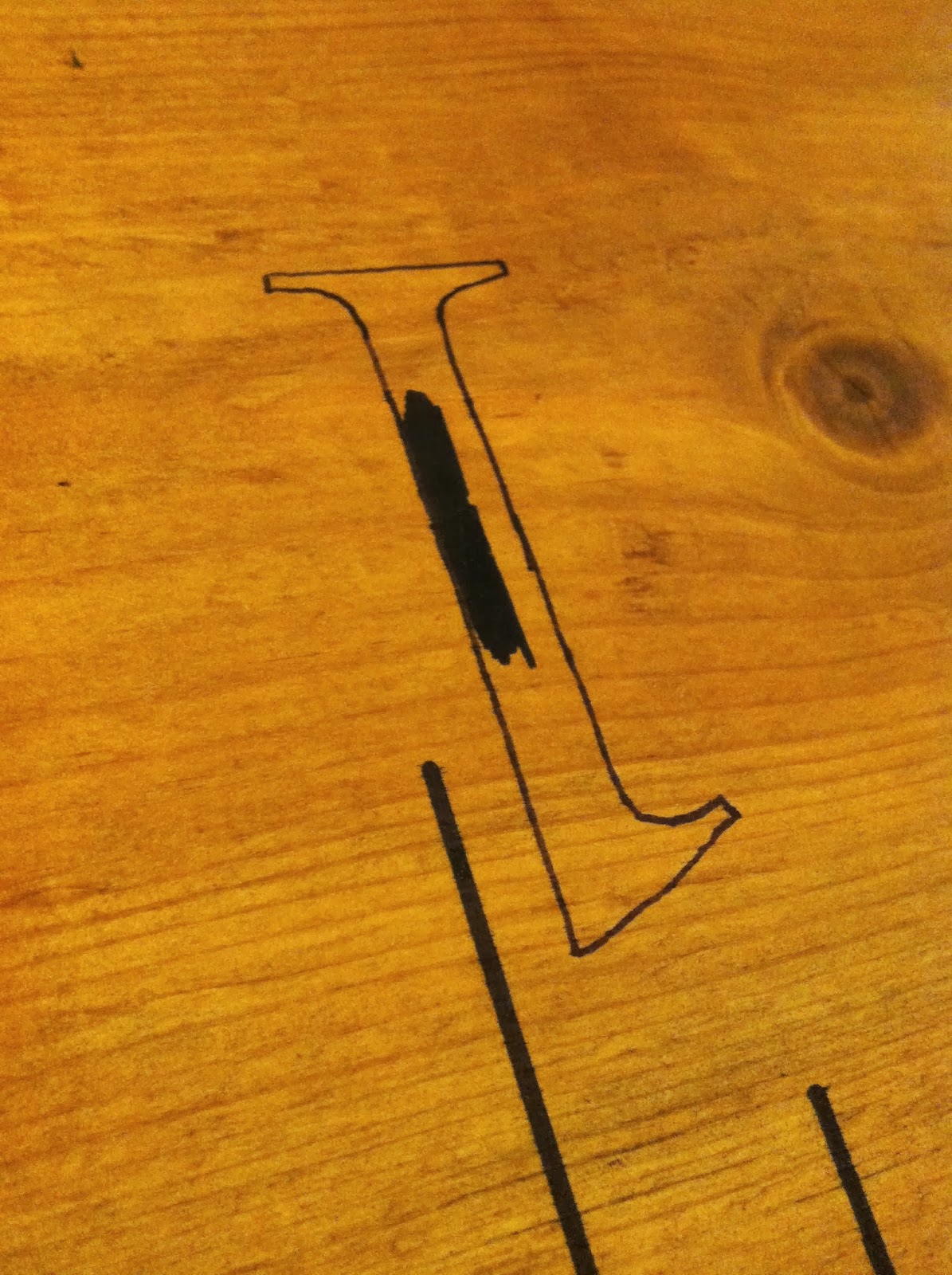
One of the projects I recently crossed off the craft list is a ruler height chart for our soon-to-be growing family. I’m so happy with how it turned out and the best part is that the supplies were virtually free. Now comes the tough part – finding a way to mark it up and actually use it after all that hard work.
If you're looking for an attractive, low-cost way to record your children's growth milestones, this project may be for you. Read on for simple steps to make your own ruler height chart.
Cheers!
Julie
Giant Ruler Height Chart
Supplies
1. Sand your board to a point where it is smooth to the touch. Little hands will be coming into contact with this so you want to make sure there are no jagged edges or splinters. As you sand, go with the grain to prevent sanding marks. As our board was in awful shape (who knows how many years it sat outside in the elements), I had to break out the big guns and use a power sander.
2. Stain the board. I had a few old cans of stain in the garage so I tested each on the back of the board to find the best look. I used walnut. Use an old rag to apply the stain, again going with the grain. I used only one coat as I didn't want the board to be too dark.
3. Using a ruler or yard stick, make small 1'' tic marks with a pencil on the side of your board that will have the ruler lines.
4. Decide where you want your chart to start - i.e. will it hang 6 inches or 1 foot off the ground? This will tell you how to place the numbers on the chart. Ours starts 6 inches off the ground.
5. Make the ruler lines. There are two heights of line that I used - the short ones are 1.5'' and the long ones are 3''. There is a repeating pattern of 1 long, 2 short, 1 long, 2 short, etc. all the way up the board. A tool like a steel square will help you keep your lines straight. (Thank goodness my husband has a well-stocked tool bench!) Using those 1'' tic marks in step three, I marked my lines first with pencil, and then went over them with the thick Sharpie - all the while repeating to myself, "You are using a permanent marker. You are using a permanent marker." I'm just the sort to accidentally wave my hand with a Sharpie in it and then curse myself when I ruin a project.
6. Add the numbers every 12'' (depending upon where you start your ruler). I originally bought stencils and then realized I didn't need them. Back to Home Depot they went. Instead I printed 3'' numbers in Times New Roman on regular printer paper. Then I placed the sheet of paper on the board and traced each number with a ballpoint pen (using a LOT of pressure). What was left was a light outline of the number on the board. I used my thin Sharpie marker to trace the outside of the number, and used the thick marker to fill it in.
7. Our board is HEAVY. It's also slightly bowed. To hang it securely to the wall, I enlisted my husband's expertise. He used two "keyhole" hangers placed about 6'' from the top, which sit on screws anchored into the wall.
8. Done! On my son's second birthday we marked his height - for now with masking tape.
You might also like...
1. Easy, frugal and festive: Salt Dough Christmas Ornaments
2. Crochet your baby a Yoda hat
3. Throw a birthday party on a budget
Our days of late have been filled with baby preparations and spending quality time with our toddler before his little life is forever changed. As you may have noticed by the lack of posts, in recent months my blog has had to take a backseat to, well, life.
Another thing consuming my time is an uncontrollable urge to tear apart the house and get it in tip-top shape before the baby arrives. You know what I’m talking about: nesting. From re-organizing our son’s closet (which he will soon be sharing with his baby brother or sister) to finishing long-forgotten crafts and tackling big projects like replacing sliding doors, I am driven by what seems to be an internal hamster on speed.
One of the projects I recently crossed off the craft list is a ruler height chart for our soon-to-be growing family. I’m so happy with how it turned out and the best part is that the supplies were virtually free. Now comes the tough part – finding a way to mark it up and actually use it after all that hard work.
If you're looking for an attractive, low-cost way to record your children's growth milestones, this project may be for you. Read on for simple steps to make your own ruler height chart.
Cheers!
Julie
Giant Ruler Height Chart
Supplies
- Wood board: Ours is about 12'' x 1'' x 5', but you could also use an 8'' width board and/or get one closer to 6' long (if you plan to take height measurements well into the teenage years!). My husband found this one laying around at his winery so we got it for free. If you buy one it will cost about $10-$20, depending upon the type of wood.
- Sand paper
- Stain
- Ruler
- Steel Square
- Ballpoint pen
- Sharpies (thin and thick)
1. Sand your board to a point where it is smooth to the touch. Little hands will be coming into contact with this so you want to make sure there are no jagged edges or splinters. As you sand, go with the grain to prevent sanding marks. As our board was in awful shape (who knows how many years it sat outside in the elements), I had to break out the big guns and use a power sander.
2. Stain the board. I had a few old cans of stain in the garage so I tested each on the back of the board to find the best look. I used walnut. Use an old rag to apply the stain, again going with the grain. I used only one coat as I didn't want the board to be too dark.
3. Using a ruler or yard stick, make small 1'' tic marks with a pencil on the side of your board that will have the ruler lines.
4. Decide where you want your chart to start - i.e. will it hang 6 inches or 1 foot off the ground? This will tell you how to place the numbers on the chart. Ours starts 6 inches off the ground.
5. Make the ruler lines. There are two heights of line that I used - the short ones are 1.5'' and the long ones are 3''. There is a repeating pattern of 1 long, 2 short, 1 long, 2 short, etc. all the way up the board. A tool like a steel square will help you keep your lines straight. (Thank goodness my husband has a well-stocked tool bench!) Using those 1'' tic marks in step three, I marked my lines first with pencil, and then went over them with the thick Sharpie - all the while repeating to myself, "You are using a permanent marker. You are using a permanent marker." I'm just the sort to accidentally wave my hand with a Sharpie in it and then curse myself when I ruin a project.6. Add the numbers every 12'' (depending upon where you start your ruler). I originally bought stencils and then realized I didn't need them. Back to Home Depot they went. Instead I printed 3'' numbers in Times New Roman on regular printer paper. Then I placed the sheet of paper on the board and traced each number with a ballpoint pen (using a LOT of pressure). What was left was a light outline of the number on the board. I used my thin Sharpie marker to trace the outside of the number, and used the thick marker to fill it in.
7. Our board is HEAVY. It's also slightly bowed. To hang it securely to the wall, I enlisted my husband's expertise. He used two "keyhole" hangers placed about 6'' from the top, which sit on screws anchored into the wall.
8. Done! On my son's second birthday we marked his height - for now with masking tape.
You might also like...
1. Easy, frugal and festive: Salt Dough Christmas Ornaments
2. Crochet your baby a Yoda hat
3. Throw a birthday party on a budget
Sunday, December 22, 2013
Easy, frugal and festive: Salt Dough Christmas Ornaments
With our son nearly two years old, this year we can really have fun with Christmas. Over the last month we've been learning about baby Jesus, taking photos with Santa Claus, baking Christmas cookies, singing Christmas carols, and dancing like crazy to Mannheim Steamroller. Hey, don't judge. I blame my parents.
At what seemed like the last minute - about a week before Christmas - I decided I wanted to make Christmas ornaments with William. He's at the age where he can appreciate crafts, if with a very, very short attention span. Given that I was already in the midst of umpteen Christmas projects - per the usual, biting off too much for the season - I wanted to find something that was easy. No rushing to the craft store for supplies, no cutting 100 pieces of felt, no glitter to clean up - you get the idea.
Enter salt dough Christmas ornaments. You know - those crumbling things on your parents' Christmas tree that you made when you were two. I had just about all of the ingredients/supplies I needed in the house and the instructions were super simple. We could make one for us and at the same time do one for the grandparents, aunts, uncles - perfect! What's better, with a few extra steps I could (hopefully) strengthen the ornaments so that, twenty years from now, they're not crumbling as well.
Whether you're looking for a last minute kid-friendly Christmas ornament project or just something fun to do over the holiday break, you can't go wrong with these simple crafts. Below are instructions on how to get started.
Merry Christmas!
Julie
Salt Dough Christmas Ornaments
Recipe will make 6-8 ornaments
1 cup flour
1/2 cup salt (I used kosher because it's all I had on hand - wouldn't recommend, but it still worked)
1/2 cup water
Straw
Cookie Cutters
Paint (acrylic or water-based, though acrylic should hold up better over time)
Paintbrushes (or fingers for water-based paint)
Ribbon
Optional (to strengthen/seal the ornaments): Gesso and Gel Medium
1. Preheat oven to 250 degrees.
2. Mix the flour, salt and water together and work into a dough. Knead the dough on a floured surface until it becomes smooth. It should not be sticking to your hands - if so, add more flour.
3. To make your ornaments, you can either roll it out as a cookie dough and use cookie cutters, or roll little freehand circles or other shapes. You could even do a handprint or footprint. You want the end result to be about 1/4 inch think. Have fun here and get your child involved!
4. Use a straw to make a hole at the top of each ornament.
5. Put onto an ungreased cookie sheet and bake for two hours.
6. Remove from oven and allow to cool.
7. If using the gesso (which is basically a primer that will turn your ornaments white), apply this now. I timed the project so I could put the gesso on the ornaments while William was napping. It dries very quickly.
8. Get out paint and paintbrushes for your child and let them go crazy!
9. When the paint is dry, if you would like to seal your ornaments and make them shiny, apply a few thin coats of a glossy gel medium.
10. Thread ribbon through the hole.
11. Hang on the tree with your little one!
You might also like...
1. Make Easy Peppermint Costumes
2. Crochet your baby a Yoda hat
3. Throw a birthday party on a budget
At what seemed like the last minute - about a week before Christmas - I decided I wanted to make Christmas ornaments with William. He's at the age where he can appreciate crafts, if with a very, very short attention span. Given that I was already in the midst of umpteen Christmas projects - per the usual, biting off too much for the season - I wanted to find something that was easy. No rushing to the craft store for supplies, no cutting 100 pieces of felt, no glitter to clean up - you get the idea.
Enter salt dough Christmas ornaments. You know - those crumbling things on your parents' Christmas tree that you made when you were two. I had just about all of the ingredients/supplies I needed in the house and the instructions were super simple. We could make one for us and at the same time do one for the grandparents, aunts, uncles - perfect! What's better, with a few extra steps I could (hopefully) strengthen the ornaments so that, twenty years from now, they're not crumbling as well.
Whether you're looking for a last minute kid-friendly Christmas ornament project or just something fun to do over the holiday break, you can't go wrong with these simple crafts. Below are instructions on how to get started.
Merry Christmas!
Julie
Salt Dough Christmas Ornaments
Recipe will make 6-8 ornaments
1 cup flour
1/2 cup salt (I used kosher because it's all I had on hand - wouldn't recommend, but it still worked)
1/2 cup water
Straw
Cookie Cutters
Paint (acrylic or water-based, though acrylic should hold up better over time)
Paintbrushes (or fingers for water-based paint)
Ribbon
Optional (to strengthen/seal the ornaments): Gesso and Gel Medium
1. Preheat oven to 250 degrees.
2. Mix the flour, salt and water together and work into a dough. Knead the dough on a floured surface until it becomes smooth. It should not be sticking to your hands - if so, add more flour.
3. To make your ornaments, you can either roll it out as a cookie dough and use cookie cutters, or roll little freehand circles or other shapes. You could even do a handprint or footprint. You want the end result to be about 1/4 inch think. Have fun here and get your child involved!
4. Use a straw to make a hole at the top of each ornament.
5. Put onto an ungreased cookie sheet and bake for two hours.
6. Remove from oven and allow to cool.
7. If using the gesso (which is basically a primer that will turn your ornaments white), apply this now. I timed the project so I could put the gesso on the ornaments while William was napping. It dries very quickly.
8. Get out paint and paintbrushes for your child and let them go crazy!
9. When the paint is dry, if you would like to seal your ornaments and make them shiny, apply a few thin coats of a glossy gel medium.
10. Thread ribbon through the hole.
11. Hang on the tree with your little one!
You might also like...
1. Make Easy Peppermint Costumes
2. Crochet your baby a Yoda hat
3. Throw a birthday party on a budget
Saturday, June 15, 2013
Have a fun & frugal Father's Day
In celebrating holidays, our family has found that we don't need to spend a lot of money on gifts to communicate how much we care for one another. In fact, I've discovered that the less money we spend, the more creative and thoughtful we are in our gift giving.
This year for Father's Day, Will and I did a little "I love Dad" photo shoot in our backyard with some sidewalk chalk. (If there are any procrastinators out there, this idea is both frugal and a good last-minute gift idea.) It doesn't need to be perfect - just have fun!
On Father's Day we're going to let Dad sleep in, have a lazy breakfast with Eggs Benedict (Dad's favorite), present him with our gifts and let him put his feet up for the rest of the day. Unless, of course, he'd rather spend his "day off" working in the garden - we frugal folk aren't good at sitting still for long.
What are some of your favorite frugal Father's Day crafts or gifts?
Cheers to dads!
Julie
Friday, February 1, 2013
Throwing a birthday party on a budget
Our little boy is turning one! Strange as it may seem, there was a part of me (OK, let's be real - the whole me) that thought this day would never come. That our little man would stay little forever. Denial? Perhaps. Well, earth-to-mom - time only starts moving faster after having kids.
After I got over the initial shock that this day was indeed upon us, it was onto the fun part - planning a memorable (and inexpensive) get-together to celebrate Will's big day. I wanted to keep it low-key and fun - aka. not turn it into an overly orchestrated Martha Stewart-esque party that would stress me out - but in typical fashion I needed to let the creative wheels turn at least a little bit. My goals with the party were 1) fun for Will and the attending kids, 2) fun for me to plan and not too much work and 3) of course, cheap!
I'm happy to report that the party was all of the above and more. It was one of those special days that we'll never forget (especially not with all the photos snapped and videos taped), and it was relaxed enough for all of us to enjoy it - including the birthday boy and mom. From budget to decorations to - of course - the cake, below are what I hope are helpful tips on how to throw a fun and frugal birthday party.
$20 for invitations and postage
$50 for food and drinks
$20 for decorations, activities and plates/cups
$10 for goody bags
Food and Drink:
Food: I easily could have gone overboard here and had to reign myself in a few times. I made three types of tea sandwiches that were also kid friendly - hummus and roasted red pepper on wheat ($5), cheese and fig spread on wheat ($8), and cucumber, cream cheese and dill on white bread ($5). Other than that, I kept it really simple and put out some cheese cubes ($2), grape tomatoes ($3) and chips ($2). After all, what guests are really looking forward to is the cake.
Drinks: We got a 12 pack of beer ($12), apple juice ($2), ginger ale ($1) and sparkling water ($2). We avoided drinks with bright colors, thus no worrying about stains on the carpet.
Decorations: This is a flexible part of the budget because you can do as little or as much as you want - for me, this is where I wanted to have a little fun. I bought the necessities (plates for $3 and napkins for $2), hats ($2), balloons ($5 filled), and a cute felt 'Happy Birthday' sign at Target for $5 (there is no way I could have made that for less). To add a little extra pizazz, I made and hung tissue paper pom poms around the house for a grand total of $4 (really, more like $2 as I didn't use all of the paper).
Goody bags: I certainly didn't need these for a first birthday party, but found some cupcake themed goody bags on sale at World Market for $2 that I couldn't pass up. I added some rubber duckies for $1 a piece and voila - done.
Planning: This is my type A personality talking, but I found it helpful to spread the to-do list out over the week so that I didn't feel overwhelmed come Friday/Saturday. As in decorate house on Wednesday, make grocery list on Thursday, shop and bake cake on Friday, etc. A little forethought here went a long way because Lord knows life is unpredictable with a soon-to-be one-year-old!
Video and Photos: Get some help here! You simply can't do it all and play host at the same time - not to mention that the guest of honor is going to need a lot of your attention throughout the whole party. Ask two friends or family members to help with photos and video and let them know what you want them to capture - like your little one stuffing cake in his or her mouth (or eating crumbs off the floor...just saying...) or ripping up wrapping paper.
Have fun! Above all, once the day arrives go with the flow and don't sweat the small stuff. The most important thing is to enjoy the company of family and friends and help your little one feel at ease. The more relaxed you are, the most relaxed everyone - including the birthday boy or girl - will be.
Being new to kids' parties, I'd love to hear other ideas for budget-friendly birthdays. From food to themes to cake to activities, please chime in with your comments!
I'm happy to report that the party was all of the above and more. It was one of those special days that we'll never forget (especially not with all the photos snapped and videos taped), and it was relaxed enough for all of us to enjoy it - including the birthday boy and mom. From budget to decorations to - of course - the cake, below are what I hope are helpful tips on how to throw a fun and frugal birthday party.
$20 for invitations and postage
$50 for food and drinks
$20 for decorations, activities and plates/cups
$10 for goody bags
Food and Drink:
Food: I easily could have gone overboard here and had to reign myself in a few times. I made three types of tea sandwiches that were also kid friendly - hummus and roasted red pepper on wheat ($5), cheese and fig spread on wheat ($8), and cucumber, cream cheese and dill on white bread ($5). Other than that, I kept it really simple and put out some cheese cubes ($2), grape tomatoes ($3) and chips ($2). After all, what guests are really looking forward to is the cake.
Drinks: We got a 12 pack of beer ($12), apple juice ($2), ginger ale ($1) and sparkling water ($2). We avoided drinks with bright colors, thus no worrying about stains on the carpet.
Decorations: This is a flexible part of the budget because you can do as little or as much as you want - for me, this is where I wanted to have a little fun. I bought the necessities (plates for $3 and napkins for $2), hats ($2), balloons ($5 filled), and a cute felt 'Happy Birthday' sign at Target for $5 (there is no way I could have made that for less). To add a little extra pizazz, I made and hung tissue paper pom poms around the house for a grand total of $4 (really, more like $2 as I didn't use all of the paper).Goody bags: I certainly didn't need these for a first birthday party, but found some cupcake themed goody bags on sale at World Market for $2 that I couldn't pass up. I added some rubber duckies for $1 a piece and voila - done.
Planning: This is my type A personality talking, but I found it helpful to spread the to-do list out over the week so that I didn't feel overwhelmed come Friday/Saturday. As in decorate house on Wednesday, make grocery list on Thursday, shop and bake cake on Friday, etc. A little forethought here went a long way because Lord knows life is unpredictable with a soon-to-be one-year-old!
Video and Photos: Get some help here! You simply can't do it all and play host at the same time - not to mention that the guest of honor is going to need a lot of your attention throughout the whole party. Ask two friends or family members to help with photos and video and let them know what you want them to capture - like your little one stuffing cake in his or her mouth (or eating crumbs off the floor...just saying...) or ripping up wrapping paper.
Have fun! Above all, once the day arrives go with the flow and don't sweat the small stuff. The most important thing is to enjoy the company of family and friends and help your little one feel at ease. The more relaxed you are, the most relaxed everyone - including the birthday boy or girl - will be.
Being new to kids' parties, I'd love to hear other ideas for budget-friendly birthdays. From food to themes to cake to activities, please chime in with your comments!
Tuesday, December 25, 2012
Christmas 2012: Temporary Insanity and Peppermint Bliss
It all began with a simple question from my son's teacher at school -
"Would you like to help us with the Christmas costumes for the infant and toddler classes?"
Weeks later - surrounded by onesies, tulle, and felt, frantically sewing what would be peppermint costumes for eleven children - I had to laugh at my ability to volunteer for projects that can't help but spiral a bit out of control.
While there were more than a few moments I wondered at my sanity in taking on such a big commitment right before the holidays (which, at least in our household, is both the merriest and busiest time of year), the truth is that I love projects where I can be creative and help others. Figuring out how to make costumes that were cute and festive on a budget - and perhaps most importantly, EASY - helped to get me in the Christmas spirit (well, that and the big glass of wine I poured to celebrate when the last peppermint was complete).
Should you ever find yourself saying 'yes' to crafting Christmas cosumes for a class full of children (or just you own), here are some simple instructions on how to make peppermints for less than $1 a piece. Merry Christmas!
Materials
Red, green and white felt (I made red peppermints for the girls, green for the boys)
Tulle
Glue
White thread
White onesies or t-shirts (nearly every child out there has an old one to donate to the cause)
1. Cut a white felt circle for each peppermint about the width of a onesie. I used a medium sized bowl as a guide.
2. Cut green and red felt circles and free-form draw peppermint shapes on each. Cut along the lines to create the peppermint 'swirl' pieces.
3. Glue the swirls to the white circles. I found that regular Elmer's glue worked best - though be careful with the amount so you don't soak through the felt.
4. Once your felt peppermints are ready, it's time for the tulle 'wrapper.' Cut a square of tulle large enough that it wraps around the peppermint like a taco (with the open seam to the center back of the peppermint) and you have at least 6 inches of overhang on each side. It's better to leave too much on each side than too little - you can trim later.
5. As you make your peppermint tulle tacos, pin them to the onesies. At the end of this, all of your onesies should have peppermints pinned in the middle with the tulle in a rectangle form (open seam of tulle tucked between the peppermint and the onesie) and about 6 inches of overhang of tulle on each side.
6. Get out your sewing machine and white thread, and sew around the edge of each peppermint so that in one swoop you sew both the peppermint and the tulle to each onesie.
7. Use scraps of tulle to tie the overhang of tulle fabric on each side of the onesies, creating the little tuft of 'wrapper.' Trim the tulle to your liking.
8. Ask all of the parents to bring something white or khaki for the bottom - tights, pants, etc.
9. Have a big glass of wine.
10. Done! *
* On a trip to Target I came across some cute peppermint bags and mistletoe headbands in the $1 bin. In this case, I pushed the 'easy button' and gladly paid $22 for headpieces and bags (which I filled with bells and sewed shut) to outfit the whole class.
"Would you like to help us with the Christmas costumes for the infant and toddler classes?"
Weeks later - surrounded by onesies, tulle, and felt, frantically sewing what would be peppermint costumes for eleven children - I had to laugh at my ability to volunteer for projects that can't help but spiral a bit out of control.
While there were more than a few moments I wondered at my sanity in taking on such a big commitment right before the holidays (which, at least in our household, is both the merriest and busiest time of year), the truth is that I love projects where I can be creative and help others. Figuring out how to make costumes that were cute and festive on a budget - and perhaps most importantly, EASY - helped to get me in the Christmas spirit (well, that and the big glass of wine I poured to celebrate when the last peppermint was complete).
Should you ever find yourself saying 'yes' to crafting Christmas cosumes for a class full of children (or just you own), here are some simple instructions on how to make peppermints for less than $1 a piece. Merry Christmas!
Materials
Red, green and white felt (I made red peppermints for the girls, green for the boys)
Tulle
Glue
White thread
White onesies or t-shirts (nearly every child out there has an old one to donate to the cause)
1. Cut a white felt circle for each peppermint about the width of a onesie. I used a medium sized bowl as a guide.
2. Cut green and red felt circles and free-form draw peppermint shapes on each. Cut along the lines to create the peppermint 'swirl' pieces.
3. Glue the swirls to the white circles. I found that regular Elmer's glue worked best - though be careful with the amount so you don't soak through the felt.
4. Once your felt peppermints are ready, it's time for the tulle 'wrapper.' Cut a square of tulle large enough that it wraps around the peppermint like a taco (with the open seam to the center back of the peppermint) and you have at least 6 inches of overhang on each side. It's better to leave too much on each side than too little - you can trim later.
5. As you make your peppermint tulle tacos, pin them to the onesies. At the end of this, all of your onesies should have peppermints pinned in the middle with the tulle in a rectangle form (open seam of tulle tucked between the peppermint and the onesie) and about 6 inches of overhang of tulle on each side.
6. Get out your sewing machine and white thread, and sew around the edge of each peppermint so that in one swoop you sew both the peppermint and the tulle to each onesie.
7. Use scraps of tulle to tie the overhang of tulle fabric on each side of the onesies, creating the little tuft of 'wrapper.' Trim the tulle to your liking.
8. Ask all of the parents to bring something white or khaki for the bottom - tights, pants, etc.
9. Have a big glass of wine.
10. Done! *
* On a trip to Target I came across some cute peppermint bags and mistletoe headbands in the $1 bin. In this case, I pushed the 'easy button' and gladly paid $22 for headpieces and bags (which I filled with bells and sewed shut) to outfit the whole class.
Wednesday, November 7, 2012
Bringing crochet, and Yoda, back from the '70s
This being my son's first Halloween, I was inspired to try my hand at crafting his costume. It needed to be cute but not girly (my husband quickly vetoed a lamb) and, of course, inexpensive. After much scouring of Pinterest, I came across the perfect idea - Yoda. My husband loved the Star Wars theme and the key element of the costume - the hat - presented the perfect opportunity to dig my crochet hook out of the black hole it had fallen into.
I headed to my local yarn store (Yarns on First in Napa) and found the perfect shade of green yarn in the sale bin for $7.00. After a trip to the fabric store for some cream and brown felt for a coat and belt - for a grand total of $1.29 - I had all of the materials necessary to channel the 'force' and transform our little guy into Yoda.
The coat and belt were ridiculously easy - I cut a square of cream felt to wrap around him like a jacket and made two slits for arm holes. The belt was one long piece of brown felt cut about 1.5'' thick.
The hat was another story. I hadn't touched a crochet project in at least five years and the prospect of reading a pattern - let alone figuring out how to single/double/half-double crochet again - was a little daunting.
Somewhere along the line I discovered Ravelry, an online community of crocheters and knitters where ideas, projects and patterns are shared. After signing up for a free account, I searched for "Yoda hat" and came across a few patterns that offered me a starting point. I picked out two - here and here - that had the look I was going for and didn't appear too complex.
I then sat down with the yarn, a 6.5mm crochet hook, my two patterns, the Crocheter's Companion (a good investment on my part years ago), said a little prayer for patience, and started crocheting.
After many failed attempts (my prayer for patience must have been answered), I ended up with a hat that I'm very happy with. It's a little big and certainly not perfect, but was a manageable project for a novice crocheter. I used elements of each pattern for the final result and made changes along the way as I remembered how to wield my crochet hook. Below is the 'bastardized' pattern that resulted, along with some instructions that I would have found helpful the first time around. I thank the ladies that wrote the original patterns for guiding me along the way!
Yoda Hat
Begin by making a magic loop (watch this YouTube video for a how-to)
Row 1: 10 dc (double crochet) in the magic loop. Join with 1 sl st (slip stitch) in the first dc.
Row 2. Ch 3. Increase by making a cl (cluster stitch) in every dc from the previous row.
Row 3. [1cl, 1dc] (this means repeat the pattern 1 cl, 1dc, 1 cl, 1dc, 1cl, 1dc, etc. for the entire row)
Row 4: [1 cl, 5dc] (same as above, repeat the pattern in the brackets for the entire row - 1cl, 5dc, 1cl, 5dc, etc.)
Row 5: [dc] Repeat row 5 until the hat is large enough.
Yoda Ears
Start with an 8-10 inch tail for sewing ear onto cap.
| Channeling the force... |
The coat and belt were ridiculously easy - I cut a square of cream felt to wrap around him like a jacket and made two slits for arm holes. The belt was one long piece of brown felt cut about 1.5'' thick.
The hat was another story. I hadn't touched a crochet project in at least five years and the prospect of reading a pattern - let alone figuring out how to single/double/half-double crochet again - was a little daunting.
Somewhere along the line I discovered Ravelry, an online community of crocheters and knitters where ideas, projects and patterns are shared. After signing up for a free account, I searched for "Yoda hat" and came across a few patterns that offered me a starting point. I picked out two - here and here - that had the look I was going for and didn't appear too complex.
I then sat down with the yarn, a 6.5mm crochet hook, my two patterns, the Crocheter's Companion (a good investment on my part years ago), said a little prayer for patience, and started crocheting.
After many failed attempts (my prayer for patience must have been answered), I ended up with a hat that I'm very happy with. It's a little big and certainly not perfect, but was a manageable project for a novice crocheter. I used elements of each pattern for the final result and made changes along the way as I remembered how to wield my crochet hook. Below is the 'bastardized' pattern that resulted, along with some instructions that I would have found helpful the first time around. I thank the ladies that wrote the original patterns for guiding me along the way!
Yoda Hat
Begin by making a magic loop (watch this YouTube video for a how-to)
Row 1: 10 dc (double crochet) in the magic loop. Join with 1 sl st (slip stitch) in the first dc.
Row 2. Ch 3. Increase by making a cl (cluster stitch) in every dc from the previous row.
Row 4: [1 cl, 5dc] (same as above, repeat the pattern in the brackets for the entire row - 1cl, 5dc, 1cl, 5dc, etc.)
Row 5: [dc] Repeat row 5 until the hat is large enough.
Yoda Ears
Start with an 8-10 inch tail for sewing ear onto cap.
1. Chain 16, dc in 2nd ch from hook and continue down the chain. Ch 3 & turn.
2. dc in each dc across, ch 3 and turn. Repeat this row so that you have a total of three rows that are all the same length.
3. On the fourth row, sctog (this means skip) the first 2 dc, dc to the 2nd from last dc. Sctog the last 2 crochet, ch 3 & turn (this will make the end of your ears into a triangle shape - in a nutshell, you are reducing the length of the row by 2 on each side as the triangle narrows). Continue until the ear naturally completes as you get to the end of the triangle.
Attaching the Ears
Using the 8-10 inch yarn tail you left when you started the ear, begin by sewing that through the very bottom of the ear and then pulling the yarn tight so that you 'gather' the ear - this will create the cone shape at bottom of the year. Tie off the yarn so that the ear stays in that cone shape. At that point, simply place the ears on either side of the head and use the remaining yarn to sew onto the cap. Trim any long ends and sew into the cap. You're done!
Friday, April 13, 2012
The great cloth diaper experiment
I never knew I'd be so excited about baby poop, but today's cloth diapers are something to behold.
Little engineering masterpieces, these poo containment devices are proof that there must be a diaper god. Many sport features like 'all-in-one' functionality (meaning they operate pretty much like regular diapers, notwithstanding the whole washing thing) or sizing options that reconfigure one diaper to serve from birth to potty training. And by golly, they are pretty darn cute to boot.
Researching which diaper to choose is akin to researching your next car purchase - there are countless brands and each one fits differently, has different features like Velcro or snaps, etc. Like cars, you don't really know what your'e going to get until after you purchase it...because its not like you can take these puppies out for a test drive. Well, at least that is what I thought until I discovered Jillian's Drawers.
Jillian's Drawers is a cloth diaper retail store in Ithaca, NY that also has an online store. I discovered them through an article on the Parenting Magazine website that referenced Jillian's Drawers as having a cloth diaper trial program for $10. I was shocked - how in the world is that possible when some diapers retail for $25 each or more? Well, I'm pleased to say the program does exist and I've been so incredibly impressed! I'm not asking questions - I'm just enjoying the fact that I can give these things a go without forgoing a ton of cash.
After the trial, I have to admit I'm in love with cloth diapers. They've sold me - hook, line and sinker. They're just so stinking (no pun intended...sorry, couldn't resist) easy - literally throw them in the wet bag (we use FuzziBunz), chuck in the washing machine (we use Tide original powder) and wash. Then line dry (or dry in the dryer on the low heat setting). That's it. Seriously.
After much consideration/testing/budgeting, here is our diaper stash:
Bum Genius: 2 rotating diapers for nighttime use with extra hemp liners for absorption. They never leak.
FuzziBunz: 18 for daytime use
Tots Bots Easy-Fit: 8 for daycare. The Velcro makes them so easy to use - just like a disposable! My daycare originally wasn't open to cloth diapers but when they saw these, they were on board.
While we have yet to experience cloth with, shall we say 'solids,' I'm hopeful that I'll be able to make it through that shift in the bum department with my love of cloth in tact. Only time will tell....
August update: We've been using cloth for four months now, and I'm still just as excited about these diapers as I was at the very beginning! They are holding up great. By now, we are close to net zero in our outlay of cost for the cloth diapers vs. disposable. From here on out, it's just gravy. Not to mention that they're better for our son and the environment. Have I mentioned I'm in love with these diapers?
Researching which diaper to choose is akin to researching your next car purchase - there are countless brands and each one fits differently, has different features like Velcro or snaps, etc. Like cars, you don't really know what your'e going to get until after you purchase it...because its not like you can take these puppies out for a test drive. Well, at least that is what I thought until I discovered Jillian's Drawers.
Jillian's Drawers is a cloth diaper retail store in Ithaca, NY that also has an online store. I discovered them through an article on the Parenting Magazine website that referenced Jillian's Drawers as having a cloth diaper trial program for $10. I was shocked - how in the world is that possible when some diapers retail for $25 each or more? Well, I'm pleased to say the program does exist and I've been so incredibly impressed! I'm not asking questions - I'm just enjoying the fact that I can give these things a go without forgoing a ton of cash.
After the trial, I have to admit I'm in love with cloth diapers. They've sold me - hook, line and sinker. They're just so stinking (no pun intended...sorry, couldn't resist) easy - literally throw them in the wet bag (we use FuzziBunz), chuck in the washing machine (we use Tide original powder) and wash. Then line dry (or dry in the dryer on the low heat setting). That's it. Seriously.
After much consideration/testing/budgeting, here is our diaper stash:
Bum Genius: 2 rotating diapers for nighttime use with extra hemp liners for absorption. They never leak.
FuzziBunz: 18 for daytime use
Tots Bots Easy-Fit: 8 for daycare. The Velcro makes them so easy to use - just like a disposable! My daycare originally wasn't open to cloth diapers but when they saw these, they were on board.
While we have yet to experience cloth with, shall we say 'solids,' I'm hopeful that I'll be able to make it through that shift in the bum department with my love of cloth in tact. Only time will tell....
August update: We've been using cloth for four months now, and I'm still just as excited about these diapers as I was at the very beginning! They are holding up great. By now, we are close to net zero in our outlay of cost for the cloth diapers vs. disposable. From here on out, it's just gravy. Not to mention that they're better for our son and the environment. Have I mentioned I'm in love with these diapers?
Subscribe to:
Posts (Atom)